SAP Integration
We connect your online store, B2B portal, field sales and warehouse apps to SAP Business One, S/4HANA or ECC. With SAP integration in place, products, customers and prices come from SAP, and orders reach SAP without anyone re-keying them.
Our integrated product
What's included
SAP Business One Integration
Two-way flow of items, business partners, price lists and sales documents through the Service Layer (REST/OData) or the DI API.
S/4HANA and ECC Integration
Reading materials, customers and pricing conditions, and creating sales orders, through OData services, BAPI/RFC calls and IDocs.
Connecting Your Channels to SAP
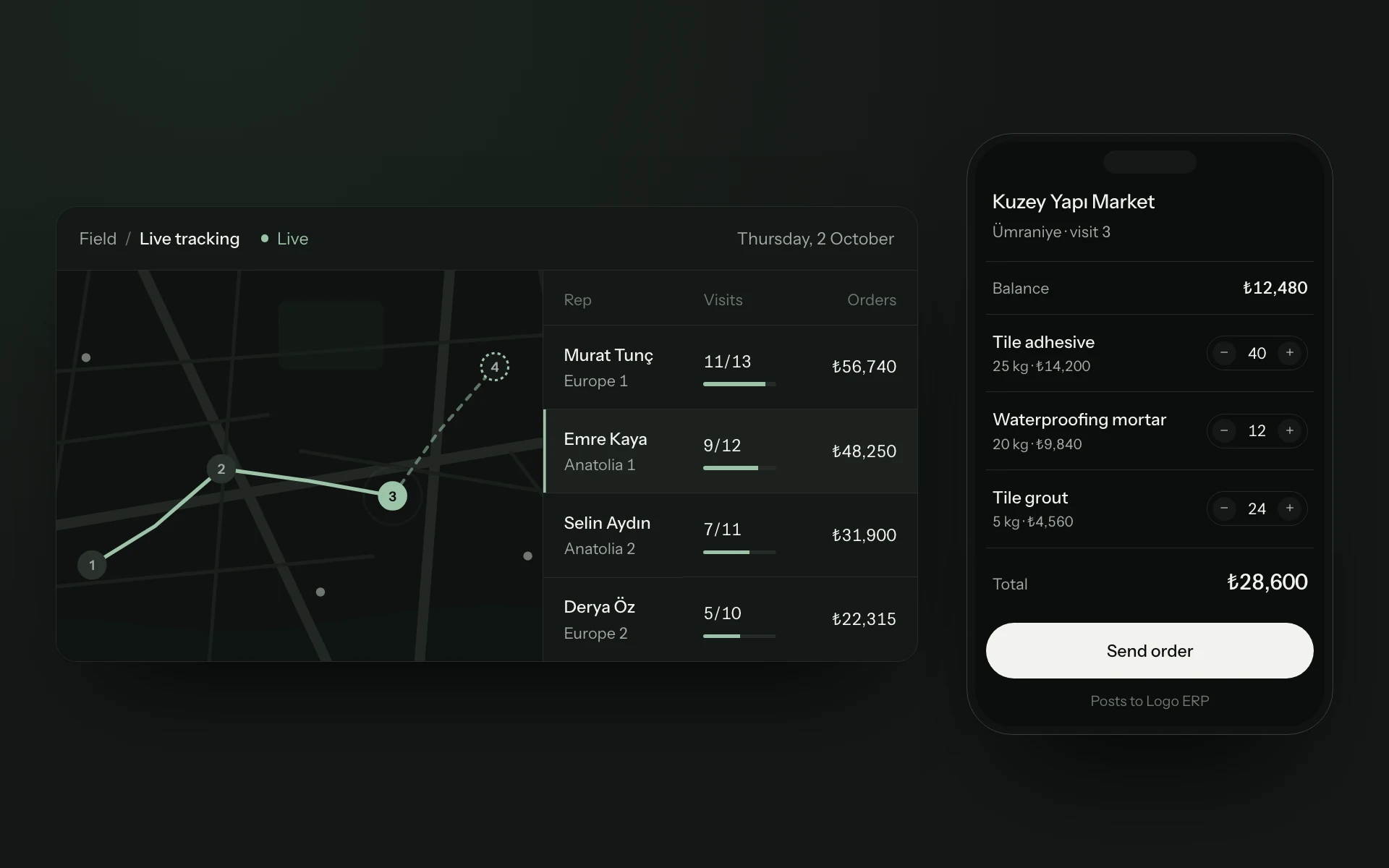
Orders from your online store, B2B dealer portal, marketplaces, CRM and BernSFA field sales app flowing into SAP through one pipeline.
Order Status and Account Balances
Delivery, billing and account balance details passed back from SAP to each channel, so customers and dealers can follow their orders and open balances on their own screens.
Web and Mobile Screens on SAP
Simple web and mobile apps that read and write SAP data for warehouse, field and approval work, suited to staff who don't use SAP GUI; if you run Fiori, we build these screens with SAPUI5.
Integration Suite or Middleware
If you use Integration Suite on SAP BTP we build the flows there; if not, we set up middleware on your servers or in the cloud that logs every transfer, retries failures and raises alerts.
Questions
How does SAP integration work?
We first agree which data moves in which direction and how often, and review your SAP release and the services available. SAP Business One is usually integrated through the Service Layer or the DI API, and S/4HANA and ECC through OData services, BAPI/RFC or IDocs. In S/4HANA and ECC, sales organisation, pricing conditions and document types also shape the design, so we work through them with your SAP team.
We already have an SAP partner. Can we still work with you?
Yes. We don't sell SAP licences or take over SAP implementation and support; that stays with your team or partner. We build the systems that connect to SAP and the integration between them, and agree the interfaces with your SAP team.
Do we need to change anything in SAP?
Usually not; SAP's standard services and BAPIs are often enough. If a field or rule has no standard equivalent and a custom OData service or function module is needed, we define it with your SAP team or partner and leave the development inside SAP to them.
We're moving to S/4HANA. What happens to our integrations?
We connect your channels to SAP through an integration layer rather than directly. When you move from ECC to S/4HANA, only the SAP side of that layer is adapted to the new system's services and data model, so changes to your online store, B2B portal and field apps are kept to a minimum.
Does connecting other systems to SAP need extra licences?
That depends on your SAP contract. Documents created in SAP by external systems can fall under SAP's indirect or digital access licensing rules, so we recommend clarifying this with your SAP account manager or partner at the start of the project.
How long does SAP integration take and how is it priced?
It depends on your SAP release, the number of channels to connect and the interfaces involved. After a discovery call we share a clear timeline and a transparent quote, as a fixed project price or a monthly retainer; you can also outline your needs in our project planner.
Related guides
All articlesHow to Integrate SAP: A Guide to Business One and S/4HANA
How to integrate SAP Business One and S/4HANA with ecommerce, B2B portals, field sales and CRM through Service Layer, OData, BAPI/RFC or IDoc, step by step.
ERP Integration Methods: API, Database and Middleware
Compare ERP integration methods: API, direct database access and middleware. Learn how to connect mobile and web apps safely to Logo, Mikro, Netsis and SAP.
B2B Ordering Portal and Dealer Management System Guide
A B2B ordering portal lets dealers order 24/7 and see their own prices and balance. Explore dealer portal features, ERP integration and a clear rollout plan.
E-Invoicing in Turkey: How to Integrate e-Fatura and e-Arşiv
E-invoicing in Turkey explained: e-Fatura vs e-Arşiv vs e-İrsaliye, private integrators, UBL-TR, taxpayer lookup and connecting your store and ERP.