B2B Ordering Portal
We build B2B ordering portals where your dealers and wholesale customers order at any hour, at their own prices and discounts, with their account balance in view. Orders go straight into Logo, Mikro, Netsis or SAP.
Related product
What's included
Dealer Pricing and Promotions
Each dealer sees their own price list, discount rates, free-goods deals and seasonal promotions, drawn from the price lists and dealer terms in your ERP.
Statements and Credit Limits
Dealers see their statement, balance, upcoming payments and outstanding cheques, and orders over the credit limit go to a manager for approval.
Fast Reordering and Order Tracking
Repeat the last order, add items by product code, upload a spreadsheet and follow each order from approval to dispatch, delivery note and tracking number.
Card Payments by Virtual POS
Dealers pay for orders or open balances by card with 3D Secure, through your bank's virtual POS or your payment provider, and the payment is posted to their account.
Two-Way ERP Connection
Products, stock, prices and balances come from Logo, Mikro, Netsis or SAP, and portal orders and card payments reach the ERP without anyone re-typing them.
Dealer App and Field Sales Link
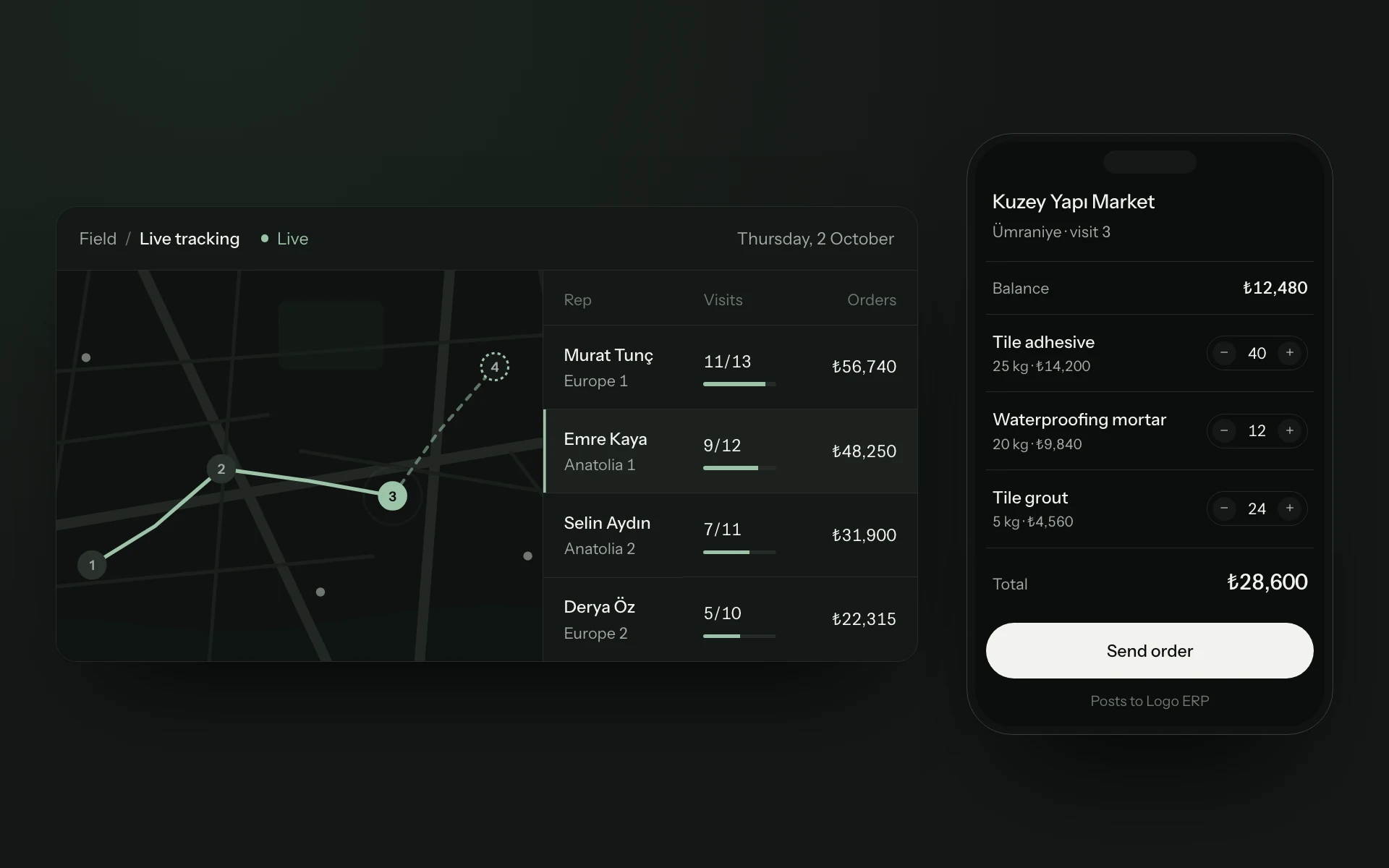
An iOS and Android app for your dealers; if you use BernSFA, portal orders also appear on your field reps' screens.
Questions
What is the difference between a B2B portal and an e-commerce site?
An e-commerce site is public: everyone sees the same price and pays when they order. A B2B ordering portal is open only to approved dealers; each one sees their own prices, discounts, payment terms and credit limit, and orders tend to be large and repeated.
Should we buy B2B software or build a custom portal?
If your pricing, discounts and approvals are fairly standard, a packaged B2B product with a ready connector for your ERP is a quick and affordable start. Once you need tiered discounts, free-goods deals, dealer-specific approvals or several warehouses, a custom portal is the better fit, even though it costs more up front.
How does a B2B portal work with Logo, Mikro or Netsis?
Products, stock, price lists and balances flow from the ERP to the portal; portal orders land in the ERP as sales orders, and dispatch, delivery notes and invoicing carry on there as usual. Orders sync immediately, while stock and prices sync at set intervals.
How long does a B2B ordering portal take to build, and what does it cost?
It depends on your product and pricing structure, your approval flows and the scope of the ERP integration; a full portal connected to your ERP can take 2–4 months. After a discovery call we give you a clear timeline and a transparent quote, as a fixed project price or a monthly retainer, and you can outline your needs in our project planner first.
Can one dealer see another dealer's prices?
No. Access is checked on the server for every request, not only in the interface, so a dealer only sees their own prices, balance and orders. Each dealer can have separate users and permissions for purchasing, accounting and management.
Will a B2B portal replace our field sales team?
No. It moves routine reorders to self-service so reps can focus on new customers and on growing existing dealers. If you use BernSFA, we set up the portal and the field app to work on the same customer, price and order data.
Related guides
All articlesB2B Ordering Portal and Dealer Management System Guide
A B2B ordering portal lets dealers order 24/7 and see their own prices and balance. Explore dealer portal features, ERP integration and a clear rollout plan.
ERP Integration Methods: API, Database and Middleware
Compare ERP integration methods: API, direct database access and middleware. Learn how to connect mobile and web apps safely to Logo, Mikro, Netsis and SAP.
Marketplace Integration Guide: Trendyol, Hepsiburada and Amazon
A marketplace integration guide for sellers in Turkey: sync products, stock, prices, orders and invoices across Trendyol, Hepsiburada, Amazon and n11.
How to Integrate SAP: A Guide to Business One and S/4HANA
How to integrate SAP Business One and S/4HANA with ecommerce, B2B portals, field sales and CRM through Service Layer, OData, BAPI/RFC or IDoc, step by step.