Custom ERP Development
We bring stock, warehouse, purchasing, sales, production and service into one web-based ERP built for your company. Where packaged ERPs don't fit how you work, we build the system from scratch or add custom modules that connect to the ERP you already run.
Related product
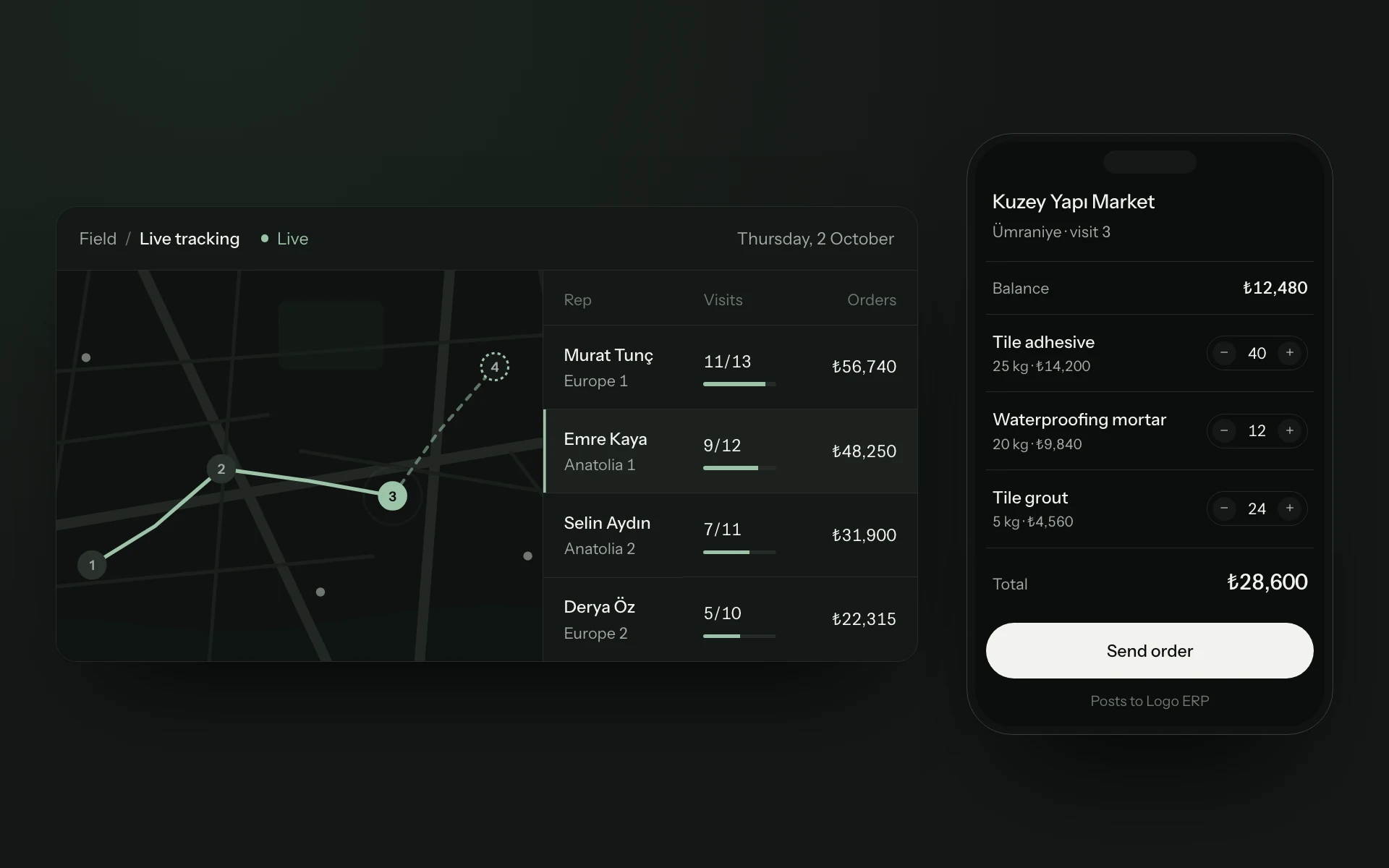
What's included
Stock and Warehouse Management
Multiple warehouses and bin locations, lot and serial number tracking, stock counts, transfers between warehouses and barcode goods receipt.
Purchasing and Procurement
Purchase requests, supplier quote comparison, purchase orders that go through approval, and delivery tracking.
Sales, Orders and Accounts
Quotes, orders and shipments, plus customer balance and credit limit checks; if you have a field sales team, BernSFA connects to the same data.
Production Planning, Quality and Service
Bills of materials and recipes, work orders, material requirements planning (MRP), quality control records and after-sales service tracking.
Accounting and E-Invoice Connection
Statutory accounting and the e-ledger (e-Defter) stay in your existing package; invoices and account movements are posted to Logo, Mikro, Netsis or SAP, and e-invoices and e-dispatch notes are issued through that package or your GİB-approved integrator.
Roles, Mobile Screens and Reports
Role-based permissions, mobile screens for warehouse and production, and live stock, order and production reports for management.
Questions
Does a custom ERP make sense instead of a packaged one?
If your processes are close to what a packaged ERP offers, the package is usually the faster and less risky start. If your production, warehouse or service work differs significantly and customising the package keeps getting more expensive, running operations on a custom ERP makes more sense. We make that call during discovery, after going through your processes together.
Will a custom ERP replace our accounting software?
We usually advise against it. Because tax rules and e-ledger (e-Defter) requirements are updated regularly, we recommend keeping statutory accounting in an established package such as Logo, Mikro, Netsis or SAP, while the custom ERP runs operations and posts invoices and account movements to that package.
Can you add custom modules to our existing ERP?
Yes. Without replacing your ERP, we build a separate module for a process it doesn't cover, such as production tracking, warehouse or service management, and connect it so data flows both ways. Because it leaves your current set-up intact, this is often the least risky place to start.
How long does custom ERP development take, and how is it priced?
It depends on the number of modules and integrations. Rather than building everything at once, we start with the most critical module, put it into use and then add the others in phases. After a discovery call we share a clear timeline and a transparent quote, as a fixed project price or a monthly retainer.
How are e-invoices and e-dispatch notes issued from a custom ERP in Turkey?
e-Fatura and e-Arşiv invoices and e-İrsaliye dispatch notes are issued through your accounting package or your GİB-approved integrator (özel entegratör). The custom ERP sends the data each document needs to that system and tracks its status, so your operations team doesn't have to switch to a second program.
Can warehouse and production staff use it on mobile?
Yes. The system is web-based; we design goods receipt, stock count, shipment and work order screens to be easy to use on phones and handheld terminals, and also deliver them as iOS and Android apps where needed.
Related guides
All articlesOff-the-Shelf or Custom ERP? A Practical Decision Guide
Off-the-shelf vs custom ERP: when Logo, Mikro, Netsis or SAP is enough, when custom ERP software pays off, plus the hybrid model, total cost and a checklist.
ERP Integration Methods: API, Database and Middleware
Compare ERP integration methods: API, direct database access and middleware. Learn how to connect mobile and web apps safely to Logo, Mikro, Netsis and SAP.
How to Integrate SAP: A Guide to Business One and S/4HANA
How to integrate SAP Business One and S/4HANA with ecommerce, B2B portals, field sales and CRM through Service Layer, OData, BAPI/RFC or IDoc, step by step.
E-Invoicing in Turkey: How to Integrate e-Fatura and e-Arşiv
E-invoicing in Turkey explained: e-Fatura vs e-Arşiv vs e-İrsaliye, private integrators, UBL-TR, taxpayer lookup and connecting your store and ERP.